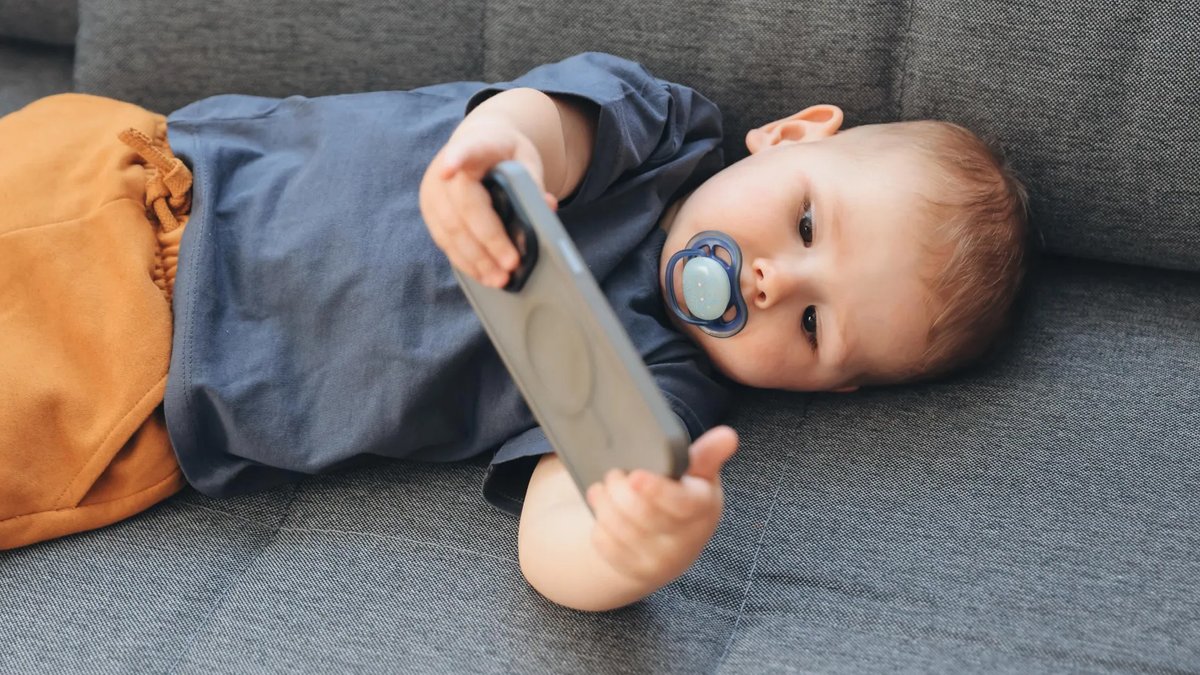
New research tracking children from infancy through middle childhood suggests that when kids start accumulating screen time may matter as much as how much they use screens. The study, published in the World Journal of Pediatrics, followed 502 children from age 1 to age 8 and found that heavier screen viewing during infancy and around age 6 was associated with lower academic performance at age 9 and weaker working memory at age 10.5.
The findings add to a mixed body of research on screens and child development. The World Health Organization and the American Academy of Pediatrics recommend avoiding screens before 18-24 months and limiting use to under one hour per day for children ages 2 to 5. Many children exceed those guidelines, yet previous studies have produced inconsistent results, often relying on single snapshots of screen use rather than repeated measurements across early childhood.
Tracking Screen Time From Infancy Through Childhood
Researchers from Inserm and the National University of Singapore used data from the Growing Up in Singapore Towards healthy Outcomes (GUSTO) birth cohort. Parents reported their children’s screen viewing at six different ages, and the team compared those measurements with academic performance and working memory assessed years later.
Related: 3D-Printed Dental Crowns Could Cut Wait Times
Higher screen exposure during certain developmental stages was linked to poorer outcomes, with the clearest patterns appearing during infancy and near the start of formal schooling. Children with greater cumulative exposure across childhood also tended to perform less well academically.
The study design matters here. Because it tracked the same children over time, they could account for family and environmental factors more effectively than cross-sectional studies. That gives the findings more weight than a single survey, though the observational nature of the work means it cannot prove cause and effect. The connection could still run the other direction — children who struggle academically may gravitate toward screens, or some unmeasured factor could influence both.
Age 1 Showed the Strongest Association
“The effect sizes we saw at age 1 were the largest among all time points we examined,” the authors said. “That suggests early infancy may be a window of heightened sensitivity, when the developing brain is particularly vulnerable to the displacement of learning interactions by screen time. We were also surprised to see that while screen use at age 2 and 3 did not show significant links, the associations re-emerged at age 6 — when children enter formal schooling. So it is not just about early years; screen use later in childhood still matters.”
The pattern was not uniform. Screen viewing at ages 2 and 3 showed no significant association with later outcomes, but the relationship reappeared at age 6, coinciding with the transition into formal education when demands on attention and memory increase.
Related: Doctors Explain Benefits of Post‑Meal Walking
Why the Timing of Screen Use May Matter
According to the researchers, the results support the general principle that “less is better” for children’s screen exposure. An extra hour of viewing per day may not produce an obvious effect in any individual child, but small shifts across a whole population could move a meaningful number of children toward poorer academic outcomes.
Efforts to reduce screen time may therefore work best when they start during infancy and continue as children approach school age. The researchers caution that screen duration alone does not tell the whole story. Future work should examine whether outcomes differ based on content quality, device type, and whether parents watch alongside their children. Early screen habits might also influence later routines, making infancy a natural starting point for setting limits.
The GUSTO study received support from the Singapore National Research Foundation and the Singapore Ministry of Health’s National Medical Research Council. Additional funding came from the Agence Nationale de la Recherche in France.
