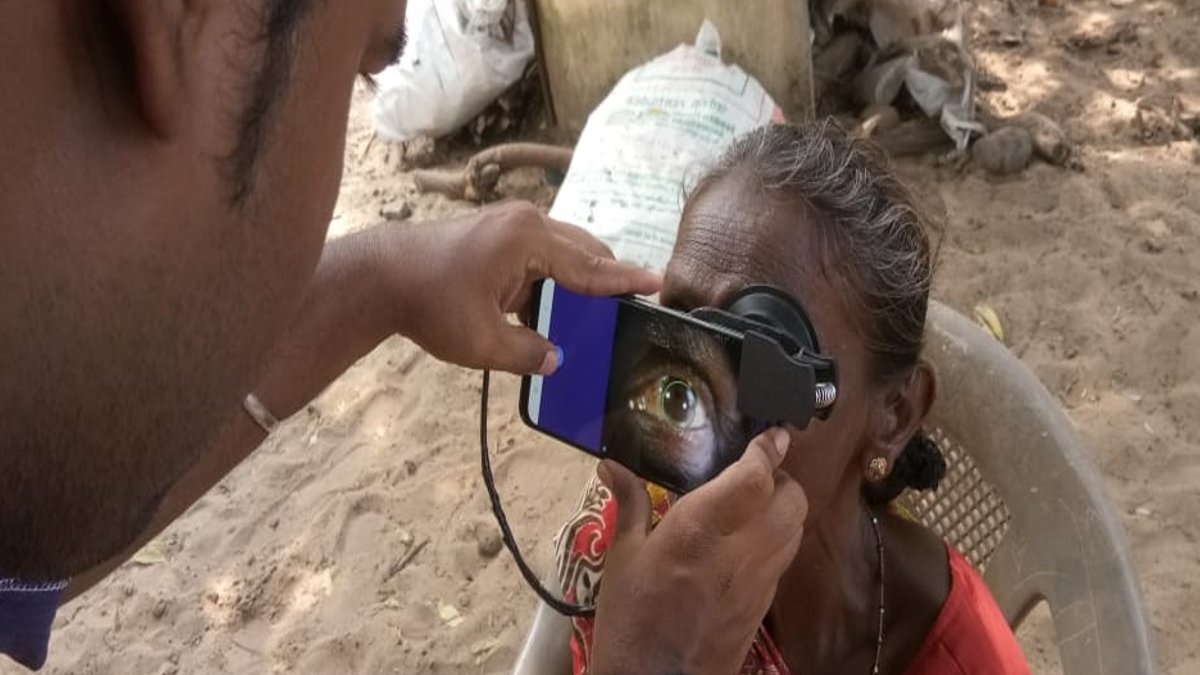
A low-cost smartphone attachment could expand cataract screening in remote areas where eye specialists are scarce. The device, developed by researchers at Aravind Eye Hospital in India and Johns Hopkins University, turns a smartphone into a diagnostic tool by adding a magnifying lens, LEDs, and a light-blocking scope—all for under £150. It’s designed to be used by community health workers with minimal training, capturing images that ophthalmologists can review remotely.
The current standard for rural eye care in countries like India relies on temporary “eye camps,” where specialists travel to villages on fixed dates. But this model is expensive, logistically difficult, and reaches only a fraction of those in need. A previous study at Aravind Eye Hospital found that eye camps screened just 7% of local residents, and a third of those who didn’t attend required cataract surgery. Women, the elderly, and poorer populations are disproportionately left out.
To test the smartphone attachment, researchers trained community health workers for three hours before deploying them to 19 rural camps in South India. Over two weeks, they screened 1,093 patients, capturing images that were later reviewed by ophthalmologists. The remote diagnoses matched in-person examinations in 89% of cases for cataracts, rising to 96% for mature cataracts, the most severe stage. When deciding whether patients needed hospital referrals, the agreement rate was 96%.
Each eye took about two and a half minutes to screen, and over 90% of images were deemed suitable for diagnosis. The quality of the images directly influenced accuracy, suggesting that improvements in lighting or optics could further refine results. Ravilla noted that the system challenges the assumption that specialists must be physically present for accurate screening.
Read Also: Targeted mRNA Nanoparticles Retrain Tumor Macrophages
The device could reallocate ophthalmologists’ time, freeing them from travel and in-person exams to focus on diagnosis and treatment decisions. For policymakers, it offers a scalable solution without requiring a proportional increase in specialist staff. The platform also works in low-bandwidth environments and integrates with existing community health worker networks.
While not a replacement for full ophthalmological exams, the attachment could serve as a triage tool, especially in areas where specialists are hard to reach. Future upgrades may include slit-beam and blue-light imaging, as well as post-dilation photography, to improve diagnostic precision. Burkhard Dick, president of the European Society of Cataract and Refractive Surgeons, emphasized that it should complement, not replace, full care.
The researchers are planning further work to continue improving the system, including adding slit-beam and blue-light imaging, as well as taking images after pupil dilation.
